Change the work without losing the people who know it.
For CHROs, transformation leads and the managers who make moves happen. See where AI changes your roles, agree pathways with your people, and fill openings from inside with evidence the receiving manager can trust.
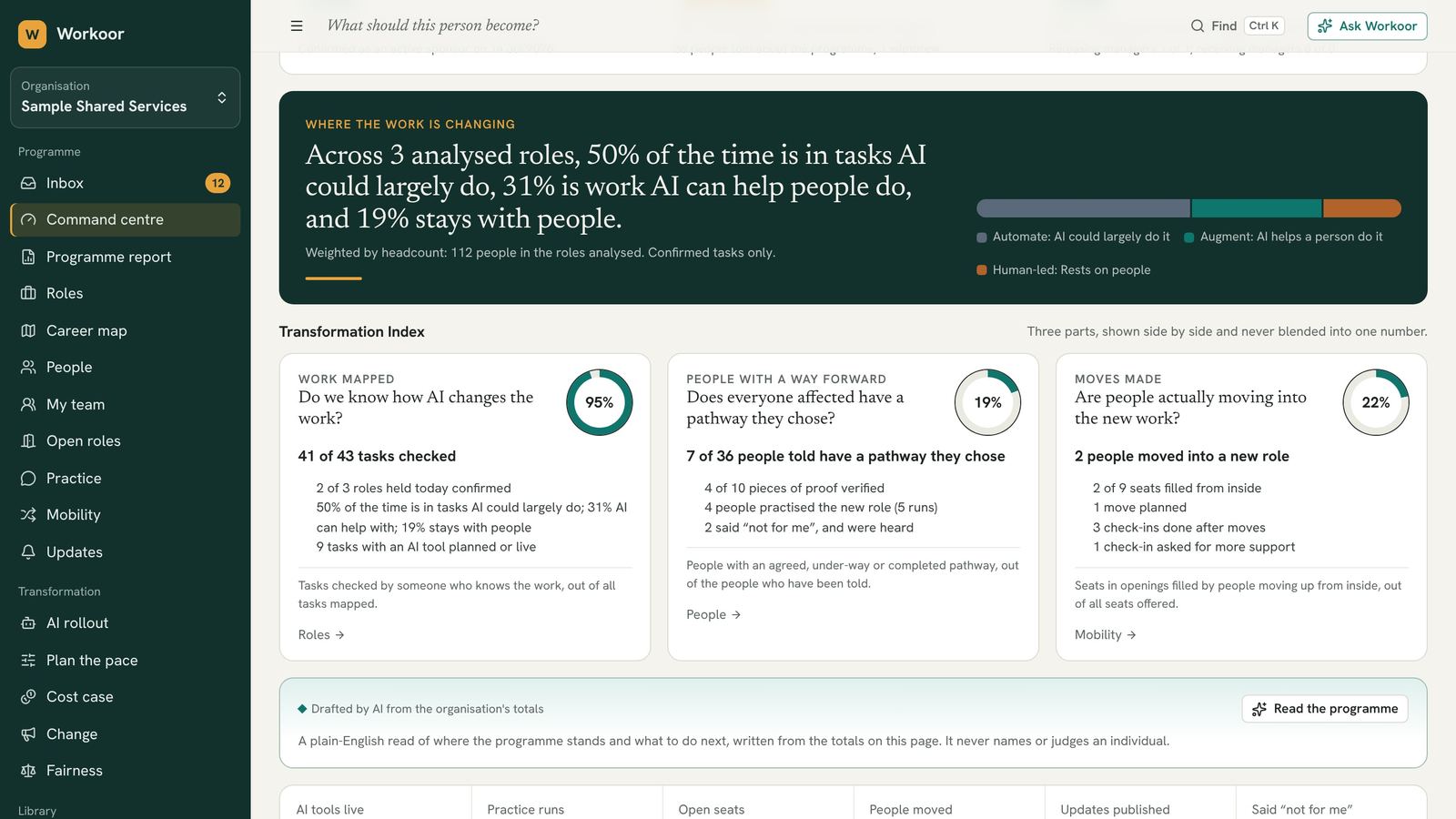
Six questions, and where Workoor answers each.
Which of our roles will AI change, and by how much?
Each role analysed as the tasks that take its time, each task's impact confirmed by someone who knows the work, and the share of time in each class.
Who could move where, and what would it take?
Routes from today's roles to the roles people could move into, how much of each destination's needs carries over, and the skills still to build, counted.
Will people be ready before the work runs out?
Month by month and role by role, the work AI frees set against the people ready to move. Try a different pace, save it, and use its dates for the rollout.
How do we know someone is ready?
Proof for each gap, with criteria agreed before the work begins, verified by someone other than the person. Practice for the new role along the way. A certificate when it's all verified.
Is it fair?
Whether pathways, proof and moves reach every gender and age group, with a four-fifths screening flag and groups under five hidden. Each person chooses whether their data is used for it.
Is it working?
The Transformation Index in three parts, never blended. Check-ins at 30, 60 and 90 days after each move. A monthly report for the steering committee, as a PDF or an editable PowerPoint deck.
Three leading signals, each against its own threshold.
Start with one function. Workoor tracks the pilot's own health from its start date and never adds the signals into one score.
A named sponsor, active
A business sponsor, confirmed as active by the end of the first week.
Every manager briefed
Each releasing manager and each receiving manager briefed by the end of week three.
People opted in
At least the share of people in scope you set, 60% unless you choose otherwise, opted in by the end of week six.
The report, saved as it stands
The steering committee's report, with what has changed since the last one, figure by figure.
What it costs to move a person up, against replacing them.
From your organisation's own inputs, with what's realised and what's potential shown separately. It is not a headcount-saving calculator, and Workoor never calls freed work a saving.
Releasing good people is a result.
Each move keeps who released the person. The programme report credits those managers by name: people moved into new roles, those at full productivity at 90 days, and those working towards a new role now.
Beyond one organisation.
Today Workoor works strictly inside one organisation: openings and moves are internal, and no record leaves it. Whether a verified record could one day help a person move between employers, with their consent, is a separate decision that hasn't been made. Nothing else on this page depends on it.
See the ecosystem we're designing towards