From a role's tasks to a move that worked.
One loop, run with each person: analyse the work, agree a pathway, prove the gaps, move, and check in at 30, 60 and 90 days. AI drafts and explains along the way. People decide.
Seven steps, each one a screen in the product.
Ten stages, and an honest status for each.
Train, verify, assess, profile, match, deploy, measure, upskill, recertify, redeploy. Select a stage to see what happens, what Workoor does today and what is still vision.
Match: roles they could move into
Ranked by a transparent skill-fit calculation with the gaps listed. Highly exposed destinations are flagged by the frying-pan check.
In Workoor today- Destinations suggested at 25% fit or more; the best three shown
- The frying-pan check on destinations with 40% or more of their time in automate tasks
- Internal openings offered inside first; interest in the person's own words
- Matching with roles at other employers, only with the person's consent
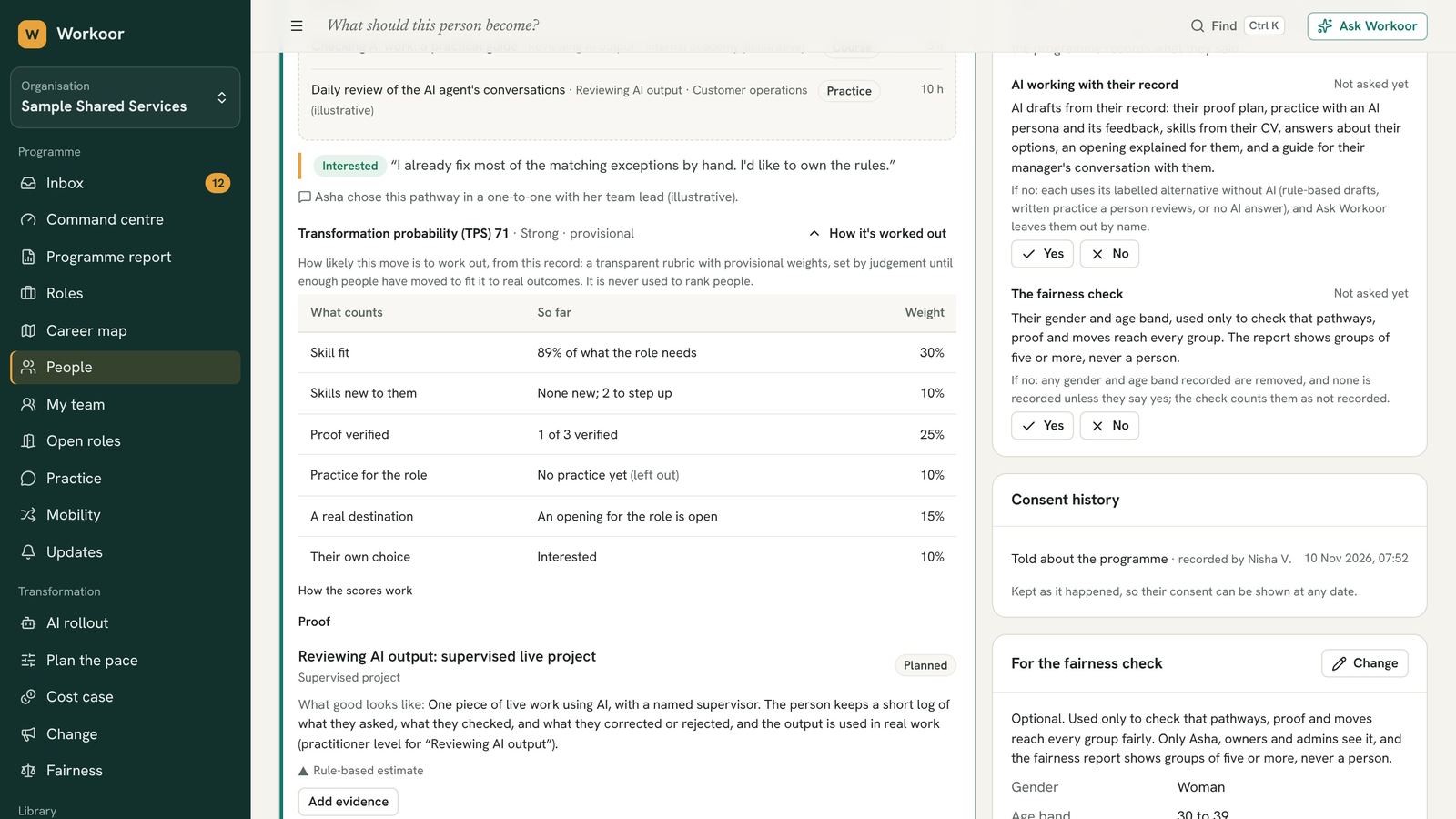
Asha's pathway: what she said in her own words, and how likely the move is to work out, with its working shown. Never used to rank anyone.
Transparent by design, and tunable per organisation.
Every figure Workoor shows can be traced to how it was worked out. The defaults below are a starting point; each organisation can change them.
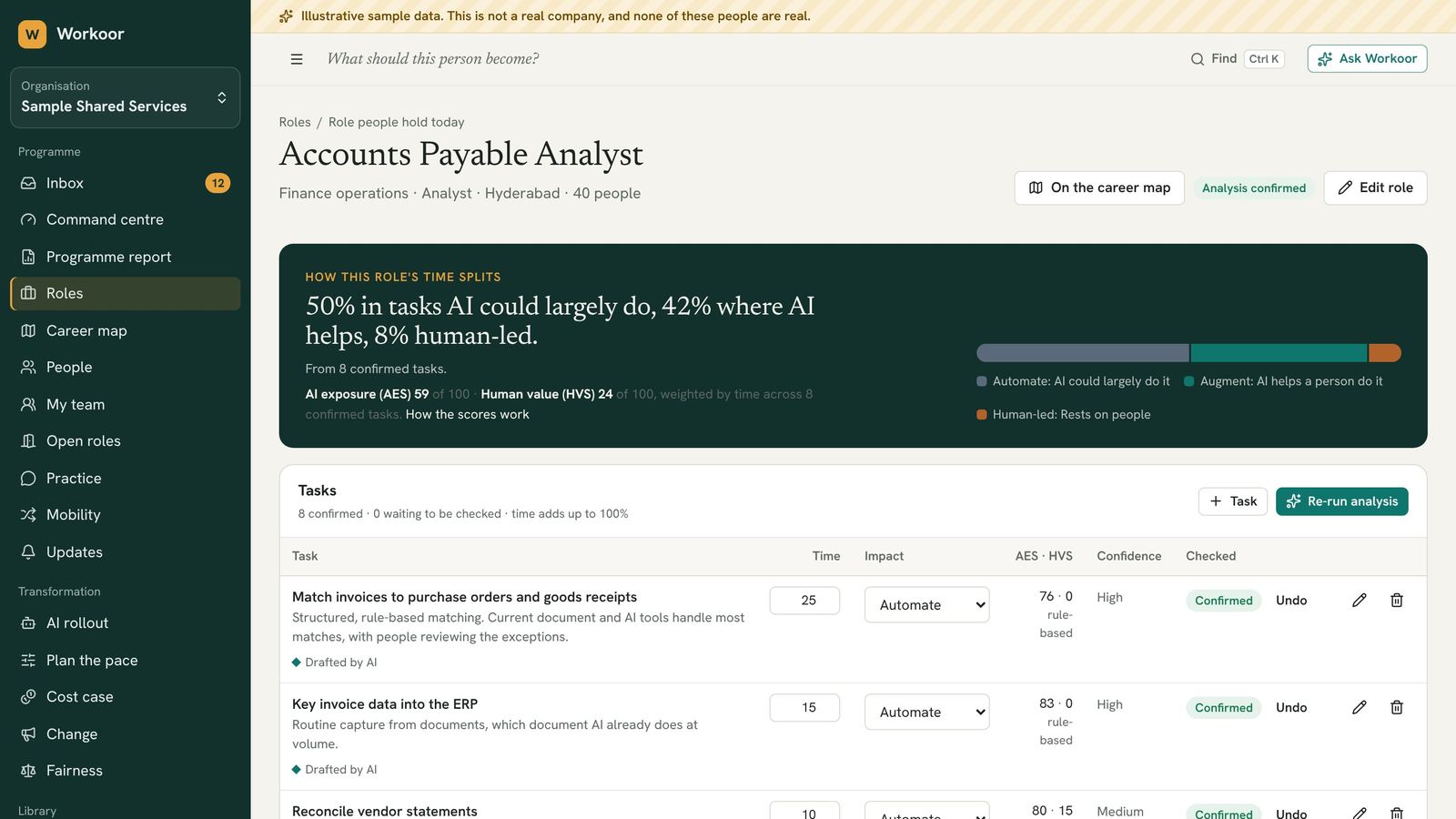
AI or software can do most of the task, with a person reviewing.
AI speeds the task up. A person still does it and is accountable.
AI offers little here. The task rests on judgement, relationships, presence or accountability.
Σ importance × min(level ÷ required, 1) ÷ Σ importance
The weighted share of a destination role's required skills a person already has. A destination is suggested at 25% or more; the best three are shown.
automate share of time ≥ 40%
A destination this exposed is flagged, ranks below the rest and says why, so nobody moves from one exposed role into another.
verified proof › assessed › self-declared
A skill's level comes from the strongest evidence available. Verified proof raises the recorded level, marked as coming from proof.
told → options → response
No pathway is suggested until a person has been told about the programme. If they withdraw, their pathways can only be declined.
AES · HVS · TPS
AI exposure and human value for each task and role, checked by people. Transformation probability on a pathway is a provisional rubric, shown with its working, never stored or used to rank anyone.
low · medium · high
Every impact estimate carries a confidence in words. Never a percentage that pretends to be more precise than it is.
AI does the drafting. People make the decisions.
Everything AI makes carries the ◆ mark and says how it was made. Every call is metered against the organisation's monthly budget, and an owner can switch AI off. Without an AI provider, a labelled rule-based pass or template does the drafting.
What AI does
- Drafts a role's tasks and their impact
- Drafts what the role becomes
- Plays the other person in practice, then gives its read
- Suggests skills from a CV, with the words that show each
- Explains an open role or a route on the career map
- Drafts the programme report's summary, every figure checked
What AI never does
- Decide anything about a person
- Rank people or pathways
- Verify proof
- Send a message to anyone
- Call freed work a saving
- See more than the person asking can see