Every part of a transformation programme, in one place.
From the first role analysed to the steering committee's monthly report. Built for the programme team, managers, each person in scope and the leaders who sponsor it, each seeing only what they should.
Sixteen screens, as they run today.
Every screen comes from the illustrative demo, a sample organisation of forty fictional people, 120 days into a programme.
What each person in the programme gets.
All of it is available today, inside one organisation.
For the programme team
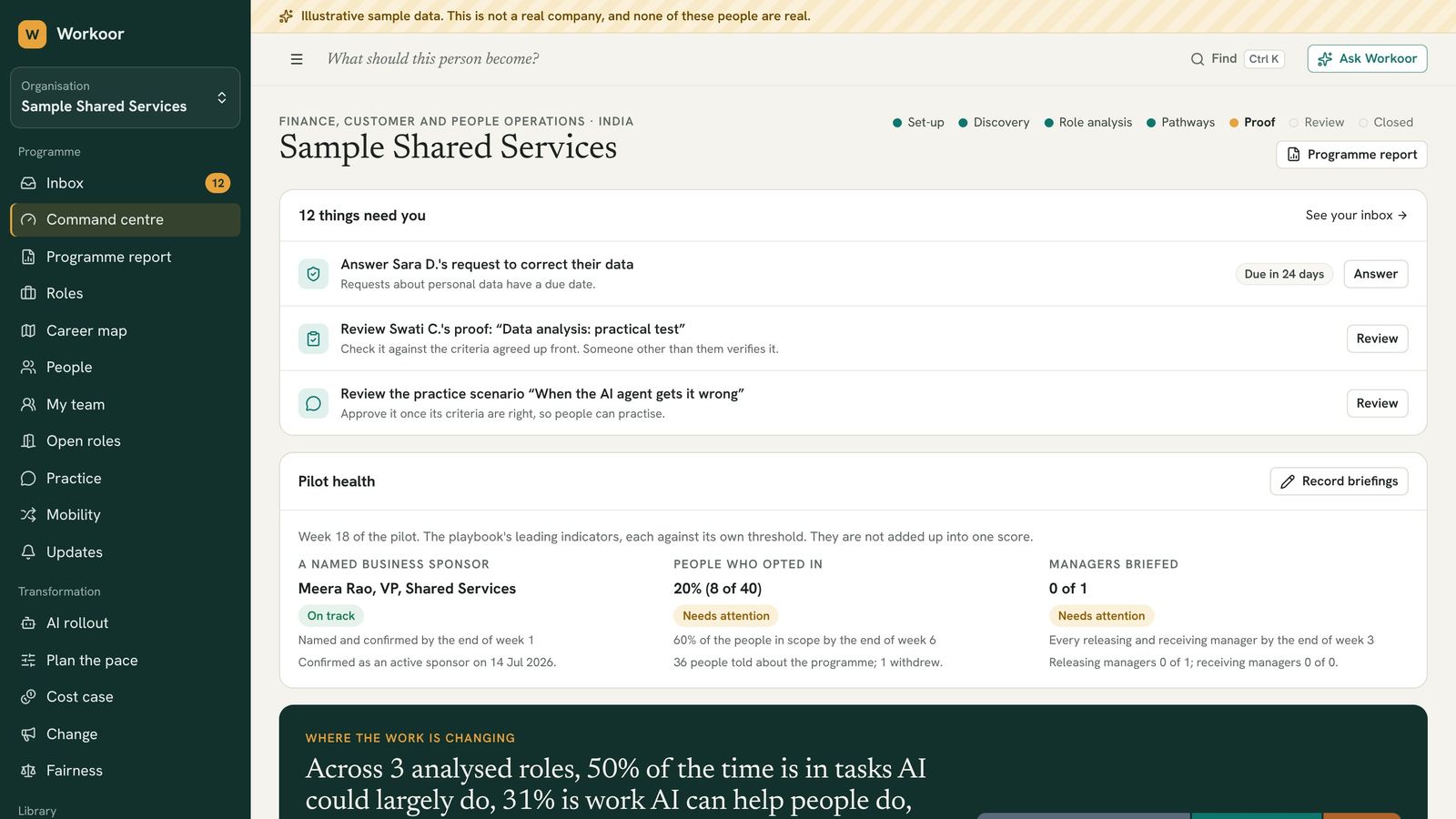
Command centre
The Transformation Index in three parts, what needs attention, and the pilot's three leading signals.
Role analysis
Tasks with a share of time, an impact class, a confidence and a reason, each confirmed by a person.
Career map
Routes from today's roles to the roles people could move into: what carries over, what to learn, how exposed each destination is.
Skills to build
Skill by skill, how many need it, have it and are proving it now, with ways to learn. AI drafts ways to learn for the team to tick.
Plan the pace
Whether people will be ready before the work AI frees runs ahead of them, month by month and role by role.
AI rollout
The tools coming in, the tasks each one changes, its risk level and how a person stays in control.
Mobility
Openings offered inside first, moves that follow a completed pathway, and 30, 60 and 90-day check-ins.
Change
Announcements, questions and answers and manager briefings, drafted by AI and approved by a person; anonymous trust pulses.
Cost case
Moving a person up against replacing them, from your own inputs. Not a headcount-saving calculator.
Import and Find
People and roles from CSV, checked before anything is written; Ctrl K to find anything you're allowed to see.
For managers
Inbox
What needs you today: reviews, agreements and check-ins, built from what you can already see.
Proof and practice
Verify proof against the criteria agreed up front, and run practice for your team.
Receiving a move
One person's evidence for the role, and a decision: accept, or decline with a reason.
Conversation prep
A copilot that prepares you for a conversation, answering only from what you can see.
For each person
What could you become?
How your role is changing, the roles you could move into, your fit and the gaps.
Open roles
The internal marketplace: your fit, an AI explanation of the role, and interest in your own words.
Practice
Conversations from the new role, with AI playing the other person and a read for your development.
Skills from a CV
Read on your own device. AI suggests skills with the words that show each; you confirm.
Your record and certificate
Your skills by the strength of their evidence, your proof, and a certificate when it's all verified.
For leaders and governance
Programme report
For the steering committee, as a PDF or an editable PowerPoint deck, saved each month as it stands.
Fairness
Pathways, proof and moves across gender and age groups, with a four-fifths screening flag.
Governance
The register of AI systems, Workoor's own uses of AI, requests about personal data, and erasure.
AI budget
Every AI call metered against a monthly budget. Owners see the spend by feature and can switch AI off.
Who sees what is decided by the database, not by the screen.
Row-level security in the database is the security boundary. No organisation can read or reference another's records, and every change is in the audit log: which fields changed and when, never their values.
| Access | Usually | Sees | Does |
|---|---|---|---|
| Admin | The transformation lead | Everything in the organisation | Settings, members and the analysis; approves communications; handles requests about personal data |
| Analyst | Whoever runs the analysis | Everything except gender and age, which only admins see | Roles, tasks, skills, pathways, proof, practice, openings, moves, AI tools, learning |
| Manager | A people manager | Role analyses, published updates and their own team's records | Assesses skills, agrees pathways, verifies proof, records check-ins |
| Employee | A person in scope | Role analyses, open roles, published updates and their own record, nothing about anyone else | Responds to pathways, self-assesses, says they're interested, submits evidence, practises |
| Viewer | An executive sponsor | Role analyses, organisation totals and the fairness report; no individual's record and no money | Reads |
A pathway is never agreed over an objection
If a person says "not for me", the database refuses the agreement. When the person has a sign-in, only they can record their response.
Nobody verifies their own proof
Proof is verified only with evidence and agreed criteria, and never by the person. "Not yet" needs feedback. Changing evidence after verification sends it back for review.
Small groups stay hidden
Fairness results and trust pulses appear only for groups of five or more, so no one can be singled out from a total.
Consent is kept as it happened
Every change to a person's consent is recorded, from what to what, when and by whom, so it can be shown at any date.
A person's choices are theirs
Whether AI works with their record, whether their gender and age band are used for the fairness check, and, where the organisation allows, whether their manager sees their practice and proof.
Erasure that keeps the figures honest
A request to delete someone's data erases what identified them. What happened stays in the totals, unnamed.